
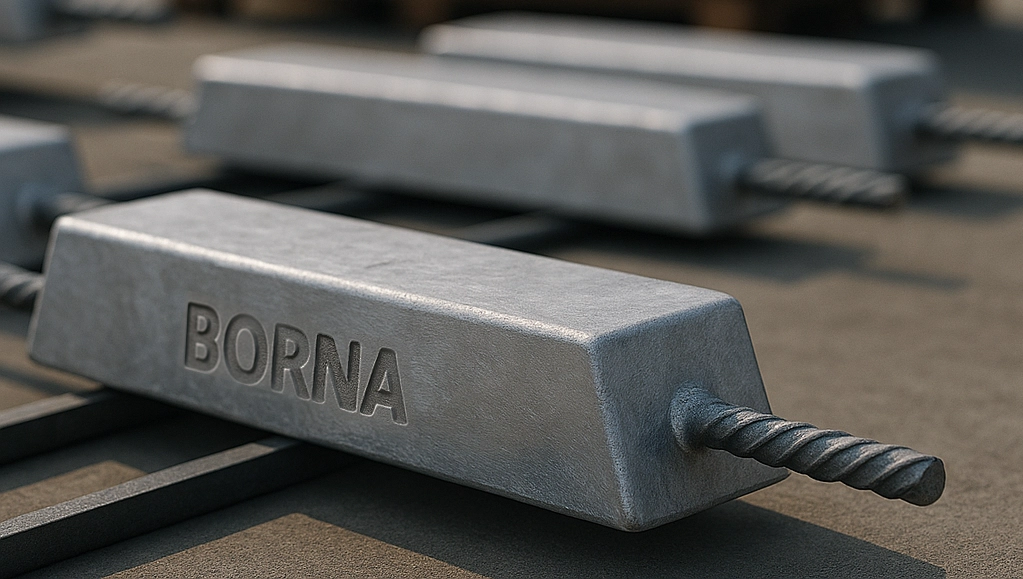
Zinc anodes protect structures immersed in fresh or saline water. Major applications include vessel hulls and ballast tanks, storage tank interiors and the external surfaces of seabed pipelines.
They also protect buried pipelines and storage tank bottoms and shells where soil resistivity is low enough to make zinc more economical than magnesium. Zinc anodes are divided by composition and application into:
A. Marine zinc alloy Type I, designed for seawater
B. Standard zinc alloy Type II, formulated for fresh water and soil

Ship undergoing repairs and anode installation
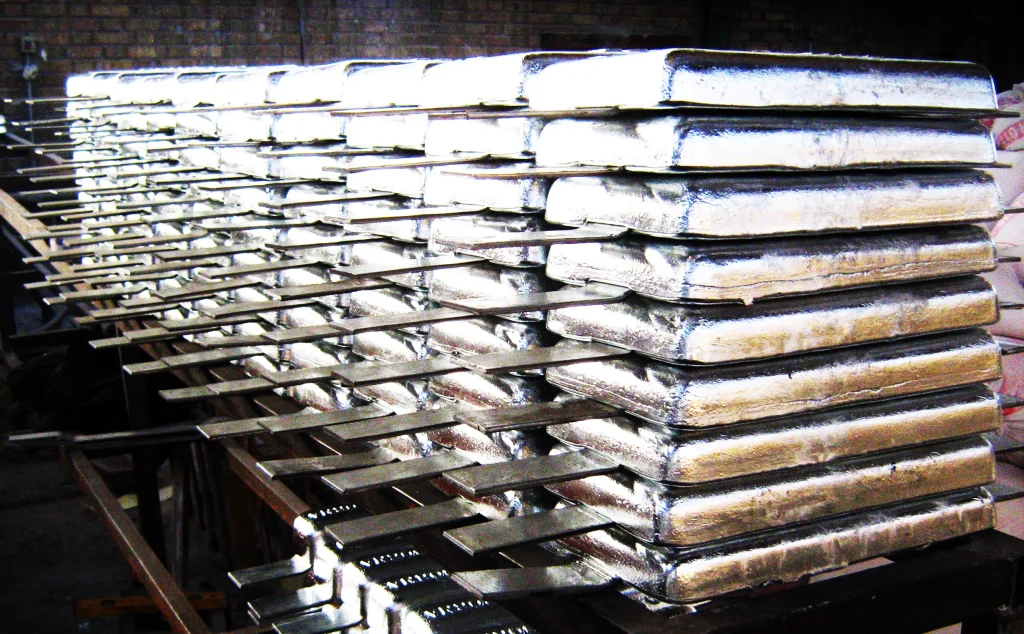
Borna Electronic zinc anodes for ship hulls
Common zinc anode standards include ASTM B418, DIN VG 81257, DNV-RP-B401, IPS-M-TP-750, ISO 15589-2, INSO 12994-2, NACE SP0387, NORSOK M-503 and MIL-A-18001K. NACE SP0387 specifies a galvanised-steel insert..
Chemical Composition of Zinc Anodes to ASTM B418
| Element (wt%) | Chemical composition | |
| Alloy type I | Alloy type II | |
| Aluminum | 0.1-0.5 | 0.005 Maximum. |
| Cadmium | 0.025-0.07 | 0.003 Maximum. |
| Iron | 0.005 Maximum. | 0.0014 Maximum. |
| Lead | 0.006 Maximum. | 0.003 Maximum. |
| Copper | 0.005 Maximum. | 0.002 Maximum. |
| Other elements | 0.1 Maximum. | – |
| Zinc | Balance | Balance |
Electrochemical Properties of Zinc Anodes to DNV-RP-B401
| Electrochemical properties | Alloy type I and II |
| Electrochemical capacity (A.h/kg) | 780 Minimum. |
| Closed-circuit potential (V vs Ag/AgCl) | Maximum −1.00. |
| Efficiency % | 95 Minimum. |
The relative potential of zinc and iron depends on electrolyte temperature. Above ambient temperature, their potential difference decreases. In some waters above 50 °C, polarity reverses: zinc becomes more cathodic than iron and accelerates its corrosion instead of protecting it sacrificially. Zinc must therefore not be used to protect iron above 60 °C.
Borna Electronic can design and manufacture zinc anodes to meet customer requirements or project needs.