
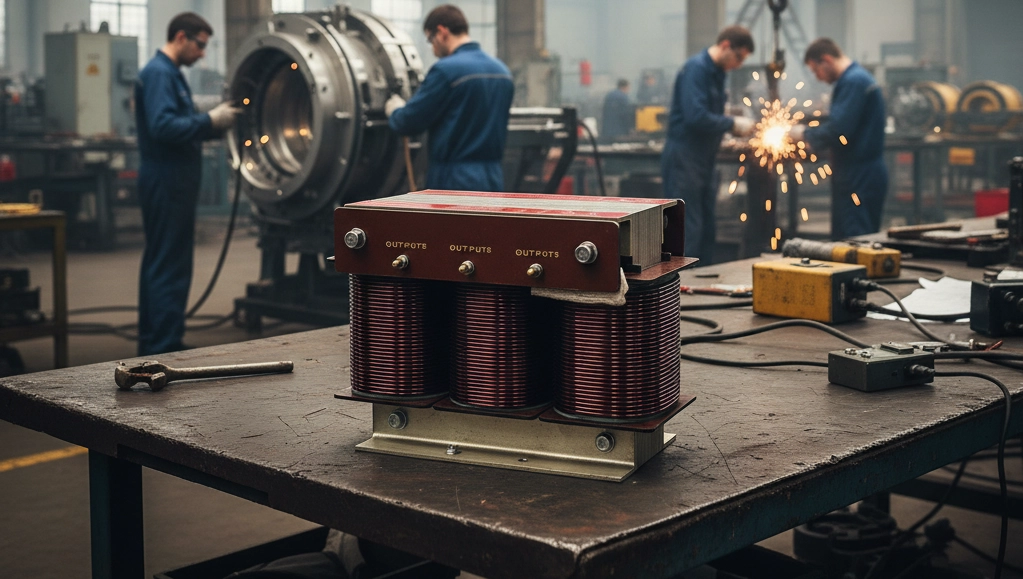
Special LV and MV Transformers
Borna Electronic is capable of designing and manufacturing various types of low-voltage and medium-voltage transformers up to 50 kV and up to a capacity of 1 MVA in single-phase and three-phase configurations. These transformers can be manufactured in different thermal classes A, B, F, and H. The standards used in the design, manufacturing, and testing of these transformers are BS171 and IEC 60076-3.
Key features of these transformers include:
- Use of cold-rolled, grain-oriented electrical steel sheets with high quality
- Use of high-quality copper conductors
- Insulation withstand capability and use of insulating materials with appropriate insulation class to eliminate the possibility of premature failure due to insulation degradation
- Design aimed at minimizing acoustic noise
- Oil-filled, air-cooled, or dry-type resin design, depending on customer request
- Quality control at all stages from design to manufacturing and testing
Rectifier Transformers
Rectifiers are converters that use semiconductor elements to convert AC supply voltage into DC voltage. Rectifier transformers are the most important components of rectifiers as suitable power supplies for rectifier circuits and must be designed in accordance with circuit conditions and special considerations related to such converters, which must be carefully taken into account in transformer design. These converters are mainly used in oil and gas industries, electrolysis, and factories producing metals such as aluminum, zinc, copper, etc.
Borna Electronic is capable of producing various rectifier transformers used in 3-, 6-, 9-, and 12-pulse rectifiers or any other complex combination.
Special considerations for this type of transformer include:
- Design for continuous-duty operation
- Optimized design to minimize space
- Optimized design to minimize current harmonics
- Optimized design to minimize leakage inductance in order to reduce commutation voltage drop in the converter
- Quality control at all stages from design to manufacturing and testing
Grounding Transformers
These transformers are used in locations where a grounding (neutral) point is not available. The connection type of these transformers is zigzag (Zn). This transformer has three windings, where the secondary winding of each phase is divided into two equal parts, and the end of half of the winding of the first limb is connected in series with half of the winding of the second limb in the opposite direction. If required, an off-load voltage regulating switch can also be considered on the main windings.
Borna Electronic Company is ready to provide services in the design and manufacturing of various types of grounding transformers.
Isolation Transformers
A one-to-one or isolation transformer refers to a transformer whose output voltage is equal to its input voltage. The use of isolation transformers between two electrical circuits causes the electrical connection between them to be effectively disconnected.
For this reason, these transformers are also referred to as separating transformers.
An isolation transformer plays the role of protecting individuals against electric shock in a circuit, because these transformers isolate or separate the network from ground, and as a result, contact with a single conductor does not cause electric shock.
Borna Electronic Company is ready to provide design and manufacturing services for isolation transformers in various types.
Power Supply Transformers for Electronic Equipment
Low-power and small transformers are used for mounting on boards and electronic and digital devices. Borna Electronic Company is capable of designing and producing various types of small pin-type and wire-type power supply transformers in accordance with customer requirements.
Toroidal Transformers
Ring-shaped or toroidal transformers are manufactured in a circular form. Depending on the operating frequency, the core material may be made of long strips of silicon steel, permalloy wound around a toroid, reinforced iron, ferrite, or new Finmet materials. The strip structure enables optimal arrangement, which by reducing core reluctance leads to increased transformer efficiency. The closed toroidal shape eliminates the air gap present in E-I core structures. Primary and secondary windings are wound compactly and cover the entire surface of the ring. This minimizes the required wire length. At equal power ratings, toroidal transformers have higher efficiency than EI types (which are cheaper).
Other advantages of toroidal transformers include:
- Smaller size (approximately half)
- Lower weight (approximately half)
- Low interference (noise)
- Lower magnetic field (approximately one-tenth)
- Low no-load losses
- Suitable for standby circuits
Transformer Tests
The specialized quality control laboratory at Borna Electronic tests the manufactured transformers in accordance with the following standards:
Routine tests (according to IEC 60076 standard):
- Measurement of winding resistance
- Measurement of voltage ratio and phase displacement verification
- Measurement of short-circuit impedance and load losses
- Measurement of no-load current and losses
Type tests (according to IEC 60076 standard):
- Temperature rise test
- Insulation type tests