
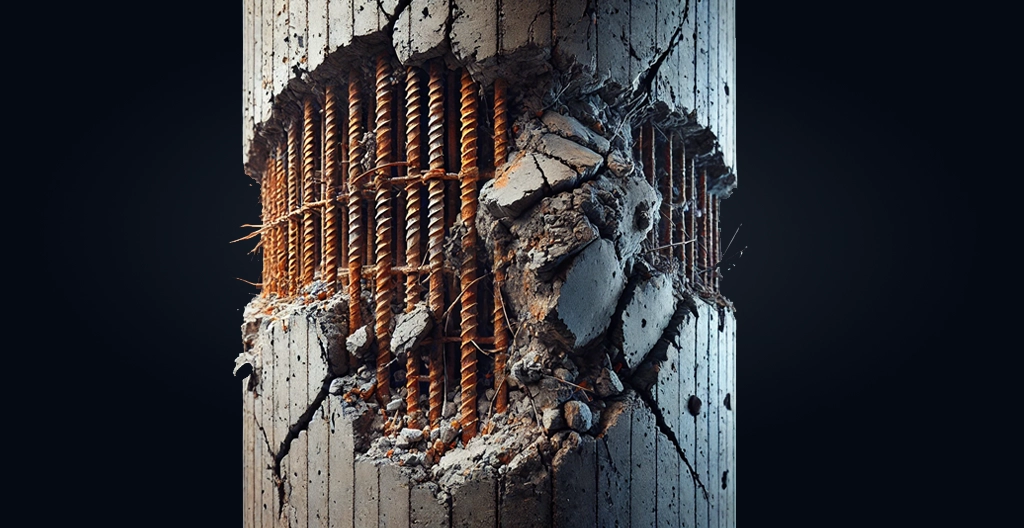
As construction and industrial use of reinforced concrete expand, deterioration and loss of strength become increasingly evident over time. As structures age, these effects can cause irreparable loss of life and property.
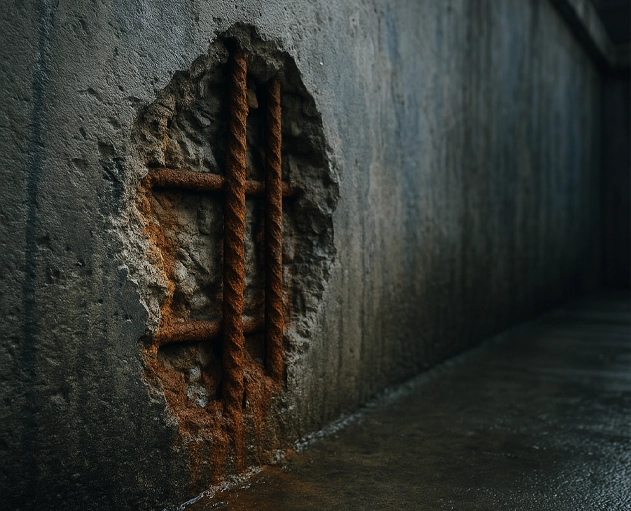
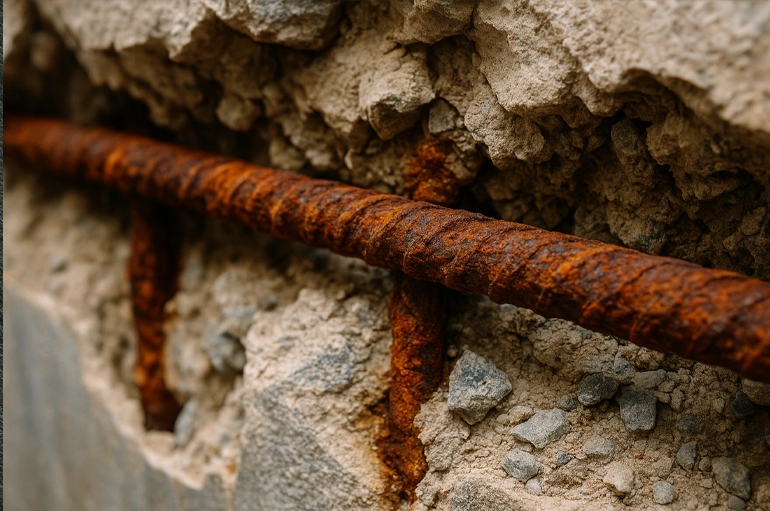
Deterioration of Reinforced Concrete Structures
Durability of Reinforced Concrete
Durability is concrete’s ability to resist weathering, chemical attack, abrasion, erosion and other deterioration processes. Durable concrete retains its shape and strength in the intended environment over a service life normally extending beyond several decades.
Research identifies corrosion of steel reinforcement as the main cause of premature damage and sometimes complete failure of reinforced concrete structures. Although steel naturally tends to corrode, reinforcement is normally protected in concrete. As indicated by the iron Pourbaix diagram, cement hydration creates an alkaline environment at approximately pH 12–13. This forms a protective passive iron oxide film around the reinforcement, preventing iron dissolution and further corrosion. While the film remains intact, the steel is nearly electrochemically inactive. Its passive corrosion rate is typically 0.1 μm/year; without the film, it corrodes at least a thousand times faster.
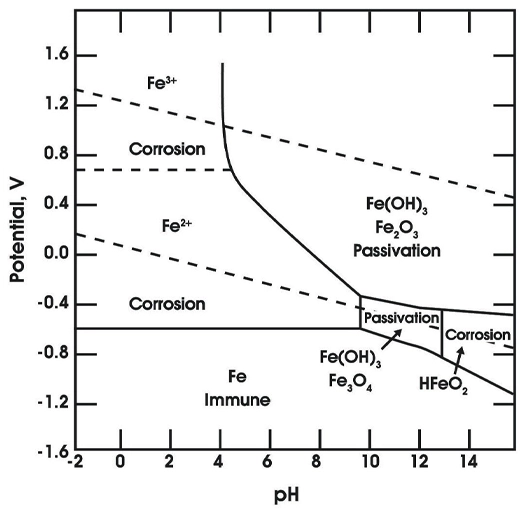
Iron Pourbaix Diagram
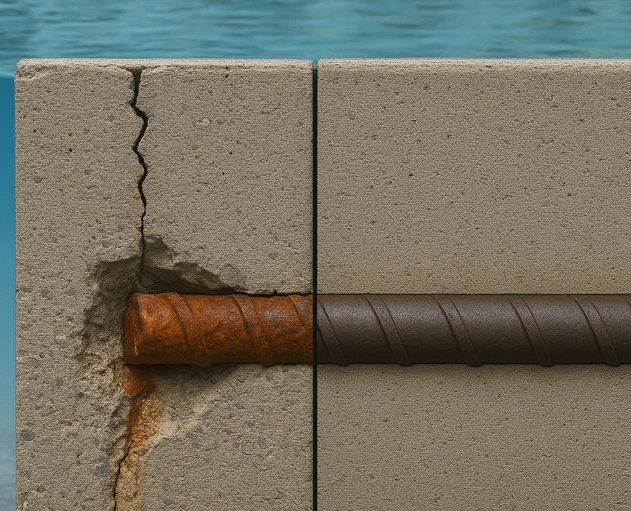
Protective Passive Iron Oxide Film on Steel Reinforcement in Concrete
If the protective film does not form or is weakened or destroyed, the steel loses protection and corrodes. Causes include:
- Excess chloride or other aggressive ions in concrete, introduced through its ingredients or penetrating from the environment
- Loss of alkalinity through reactions with aggressive gases, including carbon dioxide ingress and carbonation
- Incomplete concrete cover, directly exposing the steel to the corrosive environment
Effect of Chloride Ions in Reinforced Concrete
Chloride ingress is a major cause of reinforced-concrete deterioration. These aggressive ions destroy reinforcement passivity and initiate corrosion when their concentration at the steel surface exceeds a critical level.
Effect of Carbonation in Reinforced Concrete
Carbonation results from atmospheric carbon dioxide reacting with alkaline hydroxides in concrete. Unlike chloride attack, its effect is delayed: carbon dioxide first reacts with the concrete to form intermediate compounds, then lowers the pH and causes reinforcement corrosion.
Corrosion caused by chloride ingress or carbonation leads to cracking, loss of bond between steel and concrete, or delamination. This reduces durability and service life and ultimately damages the structure.
Assessment and Estimation of the Onset of Deterioration
Assessing reinforcement corrosion and structural deterioration requires detailed engineering examination to select the best prevention or control method. Assessment generally includes environmental conditions such as temperature, annual humidity and loading; visual inspection; chloride and carbonation levels and penetration depths; reinforcement electrical continuity; steel-to-concrete potential; concrete resistivity; and reinforcement corrosion rate.
Concrete mix and cover thickness, operating conditions and reinforcement-corrosion data can therefore be used to estimate when deterioration will begin.
Cathodic Protection Systems for Reinforced Concrete
Section 6-3 of the Iranian Concrete Code and Section 9-6 of Topic Nine of the National Building Regulations on reinforced-concrete design and construction identify reinforcement corrosion as a major cause of reduced durability and require protection. The National Concrete Durability Code for the Persian Gulf and Gulf of Oman, the Iranian Code for Port and Marine Structure Design for offshore platforms, and the Code for Cathodic Protection of Bridge Decks also address durability measures, including cathodic protection.
Reinforcement corrosion can be reduced by improving the mix, increasing cover thickness, using surface barriers or corrosion inhibitors, or using galvanised or epoxy-coated reinforcement.
Cathodic protection is another widely used method: it prevents corrosion in new construction and stops reinforcement corrosion in existing structures. It is economical, highly effective and reliable.
Applications in reinforced concrete exposed to atmosphere, water or soil include:
- Concrete bridge piers and decks
- Concrete jetty and offshore platform supports and decks
- Concrete water tanks and pools at desalination and treatment plants
- Concrete dams in sections containing reinforcement or steel plates
- Foundations and structural bodies of concrete industrial structures
- Foundations and structural bodies of concrete buildings
- And other types
Reinforced-concrete cathodic protection uses sacrificial anodes or impressed current. Sacrificial systems obtain current from the natural potential difference between the steel reinforcement cathode and a more active metal anode. Impressed current systems apply potential through an external transformer rectifier and generally use a stable anode material. Selection depends on facilities, constraints, calculations and design experience.
Selection Criteria for Reinforced Concrete Cathodic Protection
| Protection method | Sacrificial anodes | Impressed current |
| Electrical supply required | No | Yes |
| Protection life | Maximum 10 years | Minimum 20 years, extendable to 100 years |
| Potential current interference and harmful effects on adjacent structures | None | Present depending on groundbed type |
| Most common anode | Zinc | Mixed metal oxide MMO |
Sacrificial anodes are usually magnesium, zinc or aluminium, with zinc the most widely used. MMO is the most common impressed current anode, used as tube, ribbon, mesh ribbon, mesh or other forms according to conditions.
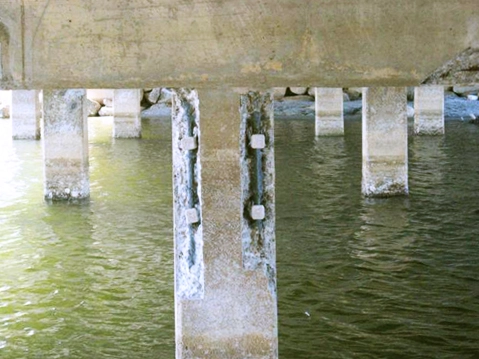
Zinc sacrificial anode installation for reinforced concrete protection

MMO ribbon anode installation for impressed current protection of reinforced concrete
Anodes can be installed on the external surface after construction or embedded during construction and concrete placement. Remote groundbeds are another option. For new structures, installing anodes during construction is generally recommended wherever access and ease of installation permit.
With more than 30 years of distinguished cathodic protection experience, Borna Electronic provides design, equipment supply, consultancy and installation for existing reinforced concrete to arrest corrosion and rehabilitate the structure, and for new construction to prevent corrosion. Monitoring systems are also available.