

As mentioned in the section on grounding resistors, high resistance grounding (HRG) is considered one of the methods of resistance grounding.
This method is mostly used for grounding the neutral point of generators where a significant reduction of earth fault current is required, which can only be achieved by using a resistor with a high resistance value.
Methods of HRG Construction
There are two methods for constructing an HRG system:
- Manufacturing a resistor with a high resistance value and low current rating
- Combining a step-down transformer with a low-resistance, high-current resistor installed on its secondary side, which is briefly referred to as NGT or NGC
The second method is generally a better solution from both technical and economic perspectives. Compared to an NGR with high resistance value, it occupies less space on site. Moreover, from the viewpoint of the generator or substation neutral point, no difference is created, since the transferred resistance value follows the transformer turns ratio formula. With precise calculation of the transformer and resistor, the same required resistance value for the system will be achieved.
The process of determining specifications for an NGC panel and the ordering procedure are similar to those of an NGR.
The process of determining specifications for an NGC panel and the ordering procedure are similar to those of an NGR.
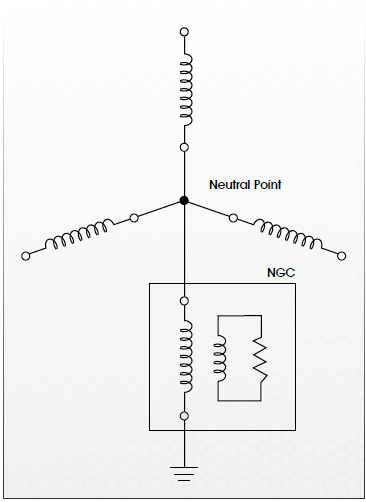
Standards and Testing
Currently, the manufacturing and testing of NGC devices comply with two standards: IEEE C62 and IEEE 32-1972.
- IEEE C62.92-2-1989: Neutral Grounding in Electrical Utility Systems
- IEEE 32-1972: IEEE Standard Requirements, Terminology, and Test Procedure for Neutral Grounding Devices
This company is capable of performing all routine tests of the various sections of this equipment in its own laboratory.
Technical Specifications
- Environmental Conditions
NGC panels are generally installed in indoor environments, as resin-cast transformers are used in them. However, upon request, they can also be manufactured for outdoor conditions.
- Temperature
-10°C to +50°C; temperatures outside this range must be declared by the customer at the time of inquiry.
- Altitude
Up to 1000 meters above sea level; higher altitudes must be declared by the customer at the time of inquiry.
- Relative Humidity
100%
- Types of Elements
Since the transformer secondary in NGC panels carries high current, resistive elements such as grid, ribbon, and casting alloy types are commonly used for this category of panels.
- Main Transformer
This transformer is manufactured with a high-quality dynamo-grade laminated core, copper windings—typically in strip form in high-current sections—and epoxy-based resin insulation.
In many cases, the transformers produced for NGC panels have successfully received test certificates from laboratories of Jihad University of Science and Technology and EPIL.
- Enclosure
NGC devices are generally supplied in indoor enclosures with IP42 degree of protection. However, upon order, outdoor enclosures with protection degree up to IP55 can also be manufactured.
- Input and Output Terminals
Input and output connections are provided from the bottom of the enclosure using stand terminals.