
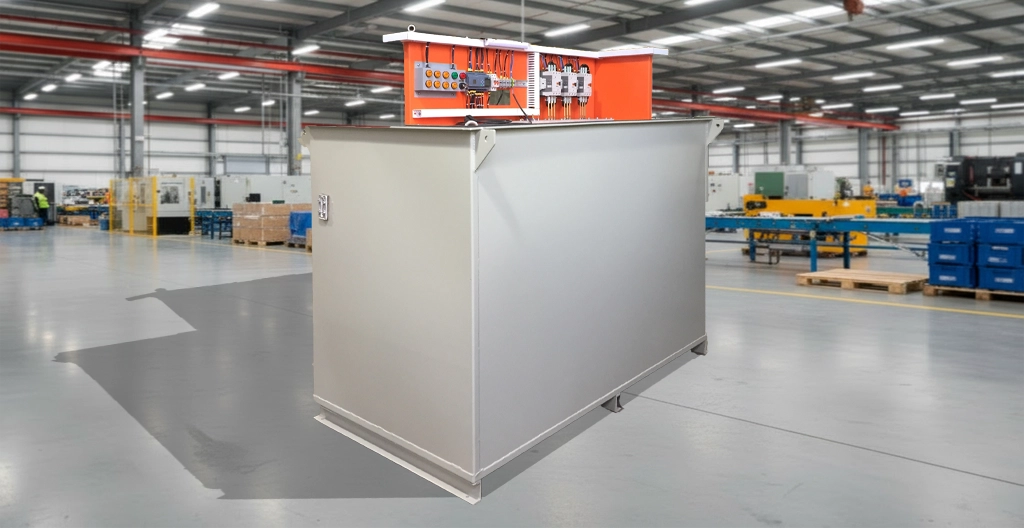
One of the important applications of industrial resistors is in the control of electric motors. This means that by selecting an appropriate resistor, it is possible both to control the electrical quantities entering the motor and to significantly adjust the mechanical output quantities of the motor, namely torque and speed, in accordance with operating conditions. These resistors are generally used in the following cases:
- In the stator circuit of asynchronous motors
- In the stator and/or rotor circuit, or both the rotor and stator circuits of slip ring motors
- In the field circuit of DC motors
- In the circuit of motors that are started using the star–delta method
The results of the operation of these resistors can be summarized as follows:
- Modification of starting torque and achieving the required matching of the torque–speed curve with the load
- Reduction of starting current at the moment of startup
- Speed control of the electric motor
- Creation and maintenance of continuous slip in motors with heavy loads
Types of Starting Resistors
- Dry-Type Starting Resistors
In dry-type resistors, industrial resistive elements—generally belonging to the family of special resistive metals in terms of material—are used. Their cooling method is natural air (AN) or forced air (AF). These types are mostly used for motors with lower power ratings (approximately up to 500 kW).
- Oil-Immersed Starting Resistors
In oil-type resistors, the same resistive elements used in dry-type starters are employed; however, the cooling method is oil-based. Therefore, they are suitable for higher power ratings. In addition, due to the relative temperature stability inside the oil, fewer resistance variations are observed in the resistors during the startup period.
Oil-immersed starting resistors are mostly installed in the rotor circuit of slip ring motors that are started under load.
The most important advantage of slip ring motors is their ability to provide high starting torque at the moment of startup. This characteristic results from their wound rotor, which allows the addition of suitable resistance to its circuit. By adding resistance to the rotor circuit of a slip ring motor, its torque–speed curve can be modified.
These types of resistors are typically used in the cement industry and other heavy industries and are applied for motors in the approximate power range of 0.5 to 1.5 MW. In this range, they are usually more economical than dry and electrolytic resistors.
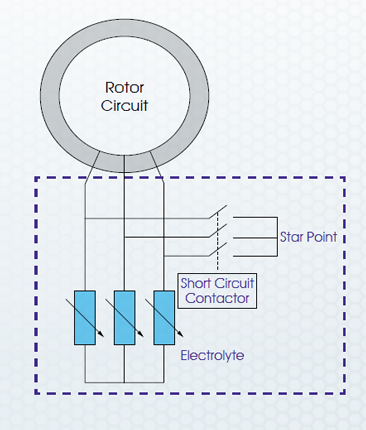
Electrical Schematic of Electrolytic Resistor
The dimensions of an oil-immersed resistor depend on the following factors:
- Motor power
- Motor load conditions (required starting torque)
- Number of starts per hour
- Starting time until reaching rated motor speed, which depends on the inertia of the motor and the load
- Number of steps provided to achieve smoother starting
The number of steps of the motor starting resistor depends on the defined torque range; the smaller this range, the greater the number of required steps.
- Electrolytic-Type Starting Resistors
In slip ring motors with higher power ratings (approximately above 1.5 MW), creating steps in the starting resistor results in relatively heavy mechanical shocks to the motor during step changes.
For this reason, continuous resistance variation during startup is required, which can only be achieved by electrolytic starting resistors. In this type of resistor, the resistance value is determined by the characteristics of the electrolyte and the distance between the electrodes installed in the electrolyte. The electrode spacing can be adjusted continuously, resulting in continuous resistance variation.
In electrolytic resistors, the liquid electrolyte is contained within a tank, and the output is provided by two movable electrodes. The distance between the two electrodes inside the electrolyte determines the resistance value; at the moment of startup, the electrodes are at their maximum separation, and at the end of the startup period, they are at their minimum distance from each other.
Therefore, resistance variation in electrolytic starters is uniform, which is the most important advantage of electrolytic starters.
Another advantage of electrolytic resistors compared to other types of starting resistors is that in the range of motors with power ratings above 1.5 MW, liquid (electrolytic) resistors usually have a lower cost compared to other starters.
Disadvantages of Electrolytic Starters
The most significant drawback of this starter is the abnormal change in resistance value with changes in the temperature of the liquid inside it. To overcome this issue, the liquid temperature must be monitored by sensors so that if the temperature increases or decreases beyond defined limits, the starter operation is prevented. In modern systems, the electrolyte temperature is returned to the normal range using auxiliary equipment (heater/cooler).
Ordering Information
For ordering, it is sufficient to provide precise information about the starting resistor, including resistance value, continuous power rating, and short-time power rating based on the startup duration. However, if resistor information is not available, at minimum the following items must be provided:
- Detailed information about the motor and rotor
- Application
- Required starting torque
- Startup duration based on application and load type
- Intervals between consecutive restarts