
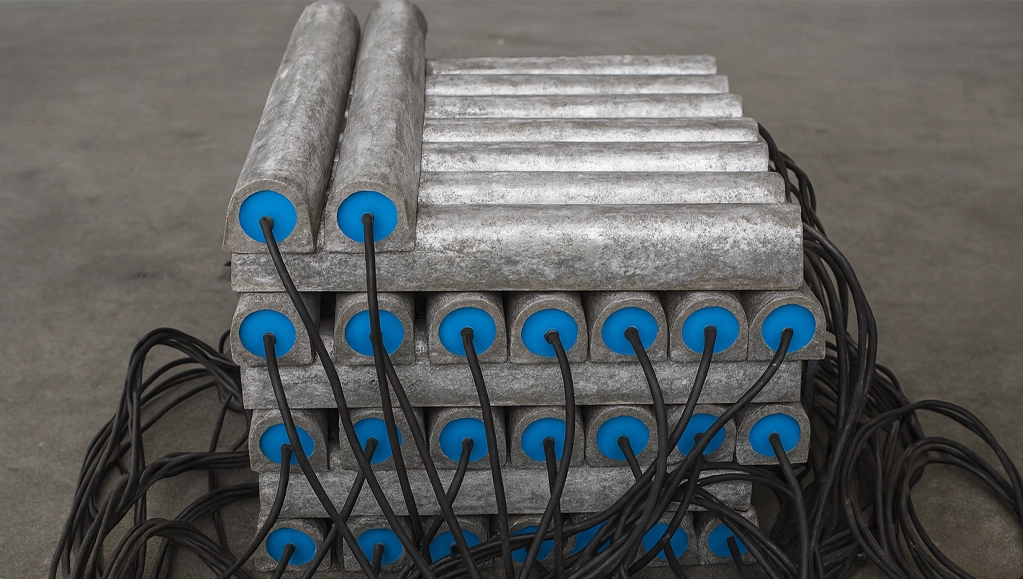
Magnesium anodes are the most common sacrificial anodes for buried structures, including oil and gas pipelines and the external bottoms and shells of storage tanks.
They also protect the interiors of water heaters and water tanks, heat exchangers, condensers and other water-contact structures operating at high temperatures. Magnesium anodes are divided by composition and application into:
A. Standard magnesium anodes AZ63
B. High-potential magnesium anodes M1C
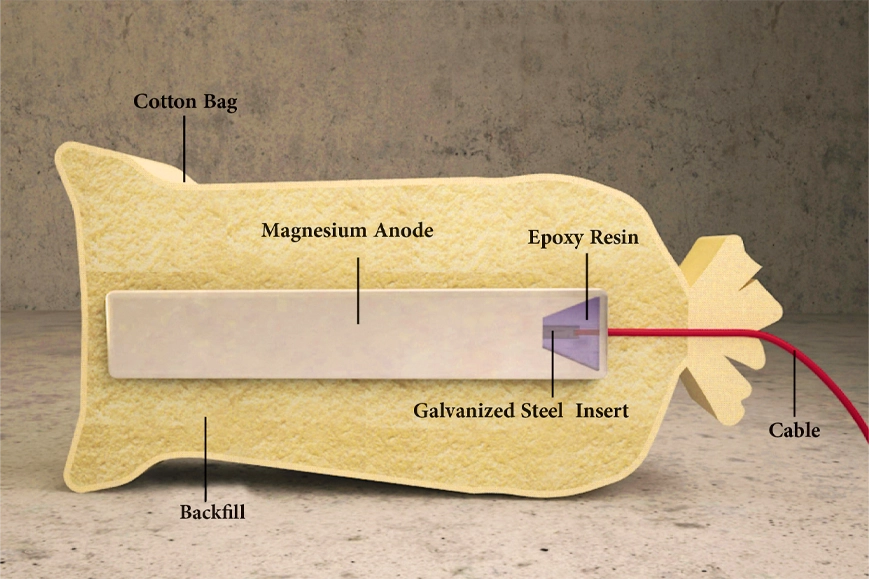
Packaged magnesium anode for soil applications and its components
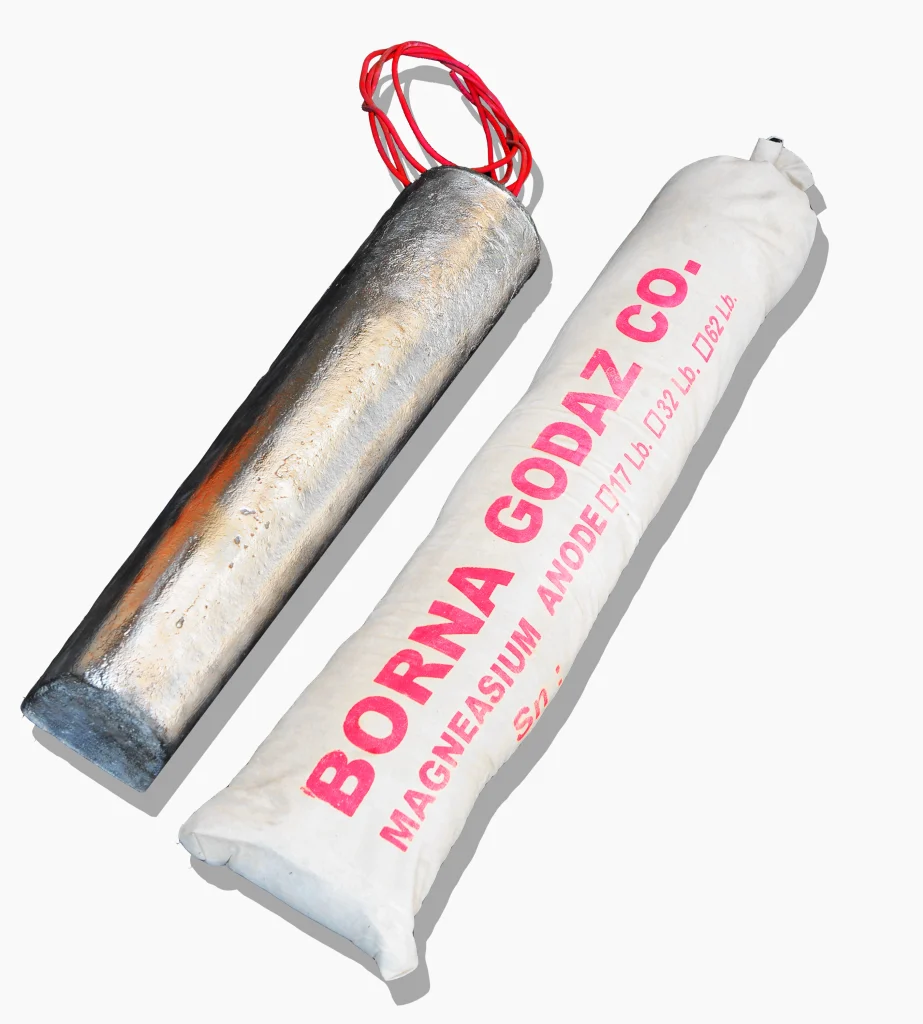
Borna Electronic packaged magnesium anodes for soil applications
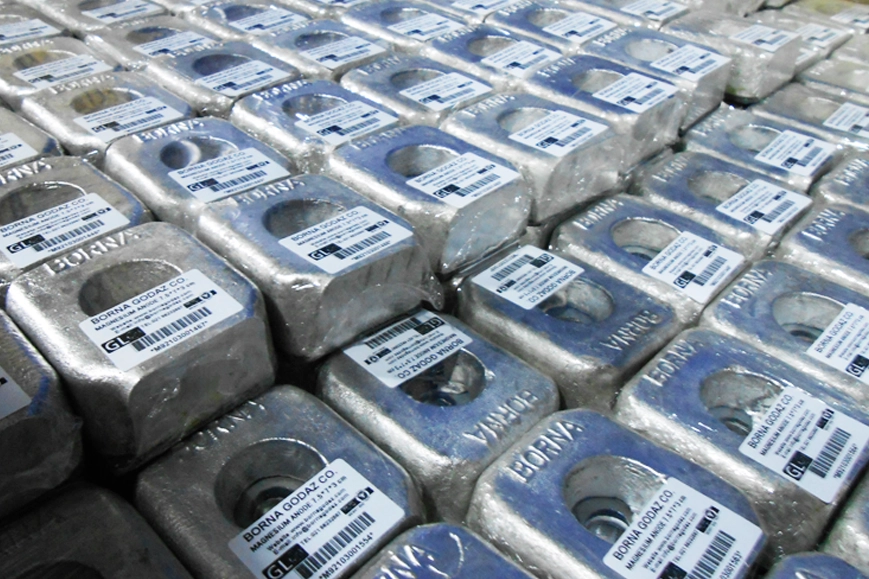
Borna Electronic magnesium anodes for heat exchangers
Common magnesium anode standards include ASTM B843, ASTM G97, IPS-M-TP-750 and NACE SP0387. NACE SP0387 specifies a galvanised-steel insert.
Chemical Composition of Magnesium Anodes to ASTM B843
| Element (Wt%) | Chemical composition | |
| Standard alloy | High-potential alloy | |
| Aluminum | 5.3-6.7 | 0.01 Maximum. |
| Zinc | 2.5-3.5 | – |
| Manganese | 0.15-0.7 | 0.5-1.3 |
| Silicon | 0.10 Maximum. | 0.05 Maximum. |
| Copper | 0.02 Maximum. | 0.02 Maximum. |
| Nickel | 0.002 Maximum. | 0.001 Maximum. |
| Iron | 0.003 Maximum. | 0.03 Maximum. |
| Other elements | 0.30 Maximum. | 0.30 Maximum. |
| Magnesium | Balance | Balance |
Electrochemical Properties of Magnesium Anodes to IPS-M-TP-750
| Electrochemical properties | Standard alloy | High potential alloy |
| Electrochemical capacity (A.h/kg) | 1200 Minimum. | 1200 Minimum. |
| Closed-circuit potential (V vs Ag/AgCl) | -1.5 Maximum. | -1.7 Maximum. |
| Efficiency % | 60 Minimum. | 50 Minimum. |
Backfill around the anode is essential for cathodic protection of buried structures. Its functions include:
- Stabilising anode potential
- Preventing anode polarisation
- Reducing anode-to-soil resistance and increasing anode current output
- Promoting uniform anode corrosion, reducing self-corrosion and increasing efficiency
- Backfill is usually a mixture of gypsum, bentonite and sodium sulphate.
- Backfill A suits low-moisture soil because its bentonite retains water.
- Backfill B is commonly used for zinc anodes.
- Backfill C suits magnesium and zinc anodes in very wet or marshy soils because it remains in place around the anode.
- Backfill D has low resistivity and suits high-resistivity soils where anode-to-earth resistance needs to be reduced.
Backfill Compositions for Sacrificial Anodes in Soil to IPS-M-TP-750
| Backfill type | Gypsum% (CaSO4) | Bentonite% | Sodium Sulphate% | Approximate electrical resistivity (ohm.cm) | |
| Hydrated | Plaster of Paris | ||||
| A | 25 | – | 75 | – | 250 |
| B | 50 | – | 50 | – | 250 |
| C | – | 50 | 50 | – | 250 |
| D | 75 | – | 25 | 5 | 50 |
IPS-M-TP-750 requires 100% of backfill particles to pass a 0.84 mm sieve, mesh 20, and 50% to remain on a 0.15 mm sieve, mesh 100. Moisture must not exceed 5%, as excessive moisture causes anode corrosion during storage.
Place the anode centrally in the backfill and compact the surrounding soil thoroughly. After covering the anode with soil, but before completely filling the excavation, add water at the anode location. After three weeks, the backfill absorbs sufficient moisture for the anode to stabilise and reach maximum current output.
For unpackaged anodes, place dry backfill manually around the anode. Once backfill and covering soil are in place, add water before completely filling the excavation, as for packaged anodes.
Backfill expands when it absorbs water, improving contact with the surrounding soil. Mixing it with water and pouring it as a slurry can leave voids when excess water is lost, reducing anode current output.
Borna Electronic can design and manufacture magnesium anodes to meet customer requirements or project needs.