
As you are aware, a resistor is inherently a device that converts electrical energy into heat.
However, the question arises as to why products in the resistor category are divided into two groups: industrial resistors and industrial heaters.
In industrial resistors, the designer or operator aims to create changes in the electrical quantities of a network or an electric motor, and the heat generated is an inherent characteristic of the resistor. Therefore, this heat is not desirable for the operator. As a result, in the production of these devices, the objective is to limit heat generation to a minimal and standard level (approximately 800°C for transient conditions and 350°C for continuous operation).
In industrial heaters, however, the objective is to utilize the heat produced by a resistive element; therefore, heat generation is desirable and is used for various applications.
In many industrial productions—especially in refineries, related industries, and gas compressor stations—it is very important to maintain the temperature of a material (mainly with liquid or gas structure). If the temperature decreases, the properties of the product or the performance of product transfer or storage equipment may be adversely affected.
In such cases, industrial heaters are used, which are manufactured in flange-type or band-type forms, among others. The flange-type heaters are usually explosion-proof.
Borna Electronic Company is proud to be recognized as one of the few manufacturers of this product in Iran, and its manufactured heaters are currently in service at several petrochemical sites in the country, such as Arak Petrochemical, Jam Petrochemical, Nouri (Borzouyeh) Petrochemical, Maroun Petrochemical, and others.
In this regard, the company is also proud to have obtained the explosion-proof (Ex d) certificate from the Iran Power Industries Laboratory (EPIL), and to be included in the Approved Vendors List (AVL) of the National Petrochemical Company of Iran (NPC) as well as the long list of the Ministry of Petroleum.
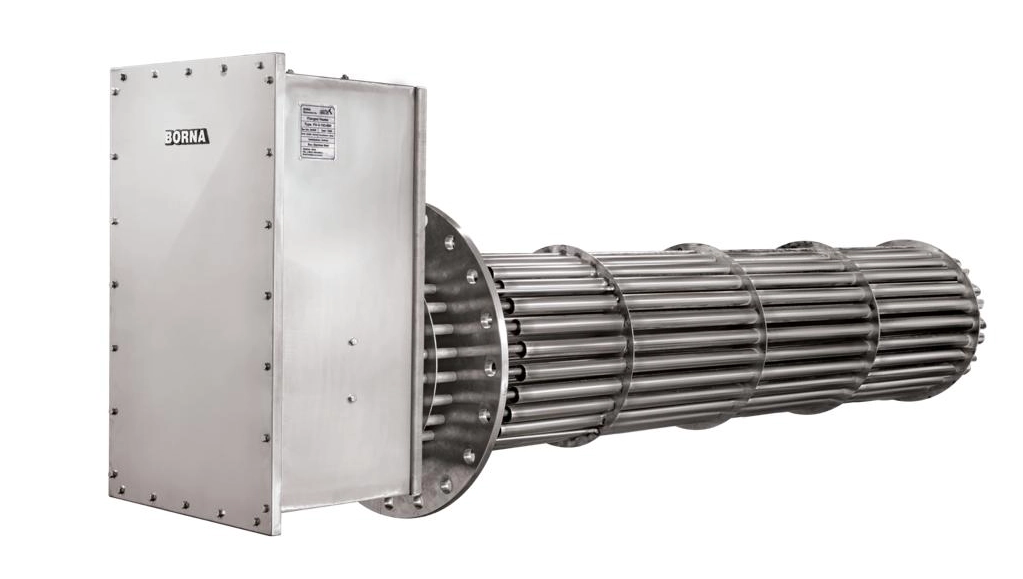
Flanged Heater (with explosion-proof enclosure capability)
Flanged heaters are commonly used in many processes involving chemical, petroleum, gas, or water-based materials, generally for liquid or gas fluids. In this type of heater, the fluid is in direct contact with the heat of the heating element, and therefore the heating is considered an internal process heating. These heaters include flanges in accordance with ANSI standards, on which a number of bent tubular heaters (U-Type) or wound-type tubular heaters are arranged on the flange surface.
In these heaters, one or more thermocouples are installed in the middle of the elements to enable measurement for thermal relays or digital controllers, allowing the system to reach the desired temperature. In this way, the conditions for internal heating of the system are established.
Flanged heaters manufactured by Borna Electronic Company are produced using various alloys to protect against corrosion and increase heater service life, depending on the type of application. A connection box is installed on the flange, which is usually welded, and in refinery applications is mostly manufactured as explosion-proof.
High precision and advanced welding techniques must be used in welding the junction box and heater elements to the flange; otherwise, leakage may occur. Since the materials of the heater, flange, and box are often different, their welding methods and filler materials follow specific Welding Procedure Specifications (WPS).
Some General Specifications of These Heaters
- Power density: 15.5 W/cm²
- Maximum power: up to 3 MW
- Voltage: up to 600 V AC
- Temperature for Stainless Steel 316: up to 650°C
- Temperature for Stainless Steel 304: up to 650°C
- Temperature for steel: up to 400°C
Band Heater
In many cases, whether due to functional and system limitations or the explosive nature of certain materials, it is not possible to implement internal heating systems, and indirect heating, or external heating, is required.
Borna Electronic Company manufactures band heaters in various dimensions, voltages, and power ratings, which are used to heat pipes and tubes that require external heating. Heating of pipes, tanks, and drums is commonly applied for oils, greases, or rotating systems.
Band heaters use electrical heating to gradually increase the temperature of the surfaces of tanks and pipes. Industrial band heaters can be manufactured with terminal boxes in accordance with NEMA 1 and NEMA 4 standards, which protect terminals against moisture ingress. In addition, equipment such as thermostatic controllers or digital thermocouples are used for temperature control and regulation.
The internal insulation of these heaters is designed to prevent external heat loss and to concentrate heat transfer inward.
Band heaters manufactured by Borna Electronic Company provide an ideal solution for high watt-density and high heating requirements, particularly in petrochemical industries. Various types of band heaters, including mica-insulated and ceramic-insulated band heaters, are manufactured by Borna Electronic Company.
Some General Specifications of These Heaters
- Final casing made of stainless steel
- Minimum internal diameter: 50 mm (2 inches)
- Minimum width: 25 mm (1 inch)
- Thickness: from 10 mm
- Maximum power: 7 W/cm² or according to design or customer order
- Heating element material: Nickel-Chromium
- Insulation support using ceramic or mica components
- Heat concentration toward the inside of the band
- Minimal heat dissipation to the outer surface
- Average internal band temperature up to 650°C
The features of Borna band heaters include high efficiency, energy saving, flexibility, durability, proper heat direction, and provision of uniform heat distribution.