

Anodic protection prevents metal corrosion by stabilising a passive oxide film on the surface. Unlike cathodic protection, which supplies current to the structure, this method draws current from the structure until the passive film stabilises. A very small current is then maintained to preserve the film and minimise corrosion.
Anodic polarisation behaviour results from a surface film that is relatively insoluble in the chemical environment. Passivation gives the metal high corrosion resistance. Anodic protection can form a passive film on metals in generally corrosive chemical systems or maintain the passive state of metals that might become active and corrode during a process. Successful protection therefore requires the metal to be capable of forming a passive film under the particular chemical composition, temperature, concentration, velocity and impurity conditions of the corrosive environment.
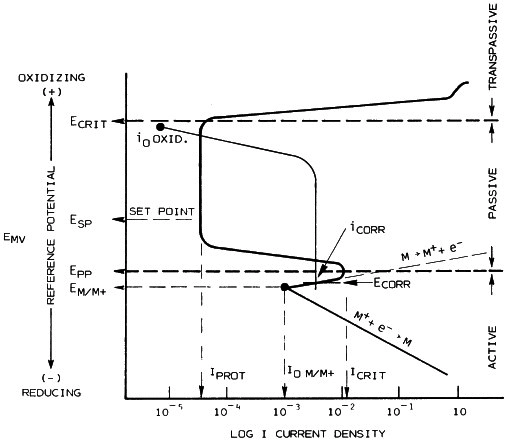
Polarisation Curve of an Active Passive Metal
Metals and Solutions Suitable for Anodic Protection
| Metals | Solutions |
| Steels Stainless Steels Nickel Nickel Alloys Chromium | Sulfuric Acid Phosphoric Acid Nitric Acid Nitrate solutions Aqueous ammonia Organic acids Caustic solutions |
Anodic protection uses a potentiostat, an electronic device that holds a metal at a constant potential relative to a reference electrode. It has three connections: one to the structure, one to the cathode and one to the reference electrode. The potentiostat responds to changes in the potential between the structure and reference electrode by adjusting the injected current, thereby maintaining a constant potential. The optimum protection potential is established through electrochemical measurements.
With more than 30 years of distinguished industrial experience, Borna Electronic provides design, equipment supply, consultancy and installation of anodic protection systems.