
A resistor inherently converts electricity into heat. Why, then, are these products divided into industrial resistors and industrial heaters? Industrial resistors alter electrical parameters in a network or motor. The heat is an unavoidable by-product, so it is kept low and within standard limits, approximately 800 °C for transient duty and 350 °C for continuous duty. In industrial heaters, the purpose is to use this heat for different applications.
Maintaining material temperature, mainly for liquids or gases, is important in many processes, especially refineries, related industries and gas compressor stations. A temperature fall can affect product properties or the performance of transport and storage equipment.
Industrial heaters serve these applications in flanged, band and other forms. Flanged types are generally explosion-proof. Borna Electronic is proud to be one of Iran’s few manufacturers of these products. Its heaters operate at sites including Arak, Jam, Nouri Borzouyeh and Maroun petrochemical plants.
The company has obtained Ex d explosion-proof certification from the Electrical Power Industries Laboratories EPIL and is included in the National Petrochemical Company NPC approved vendor list and the Ministry of Petroleum long list.
Flanged Heaters with Explosion Proof Junction Box Option
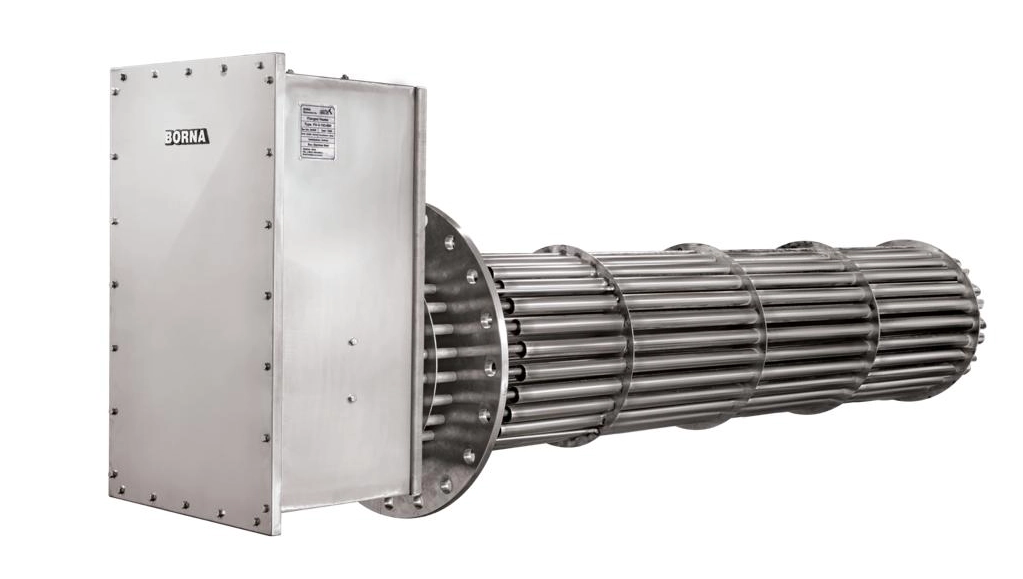
Flanged heaters are used for liquids and gases in chemical, petroleum, gas and water processes. The fluid contacts the heater elements directly, providing internal process heating. ANSI flanges carry U-shaped or wound tubular elements.
One or more thermocouples between the elements provide measurements to thermal relays or digital controllers, allowing the required temperature to be achieved.
Borna Electronic selects different alloys for corrosion resistance and long life according to the application. A junction box is mounted on the flange, usually by welding; refinery versions are generally explosion-proof.
Welding the junction box and elements to the flange requires precision to prevent leakage. Because their materials often differ, welding methods and filler metals follow specific WPS procedures.
General Specifications
- Power density: 5/15 W/cm² [source decimal notation requires confirmation]
- Maximum power: up to 3 MW
- Voltage: up to 600 V AC
- Type 316 stainless steel temperature: up to 650 °C
- Type 304 stainless steel temperature: up to 650 °C
- Steel temperature: up to 400 °C
Band Heaters
Where operating requirements or potentially explosive materials prevent internal heating, indirect external heating is needed. Borna Electronic manufactures band heaters in different dimensions, voltages and power ratings for externally heated pipes and tubes. Heating pipes, tanks and drums is commonly used for oils, greases and rotating systems.
Band heaters gradually raise the surface temperature of tanks and pipes. NEMA1 or NEMA4 terminal boxes can protect terminals from moisture. Thermostatic controls or digital thermocouples regulate temperature. Internal insulation minimises outward heat loss and directs heat inward. Borna band heaters provide an ideal solution for high-watt-density and high-heating requirements, particularly in petrochemical industries. Mica- and ceramic-insulated types are manufactured.
General Specifications
- Stainless steel outer covering
- Minimum inside diameter: 50 mm 2 inches
- Minimum width: 25 mm 1 inch
- Thickness: from 10 mm
- Maximum power density: 7 W/cm², or to design or customer requirements
- Nickel-chromium heater element
- Porcelain or mica supports
- Heat directed inward
- Minimal heat loss through the outer wall
- Average internal band temperature: up to 650 degrees
Features include high efficiency, energy savings, flexibility, durability, effective heat direction and uniform heat distribution