
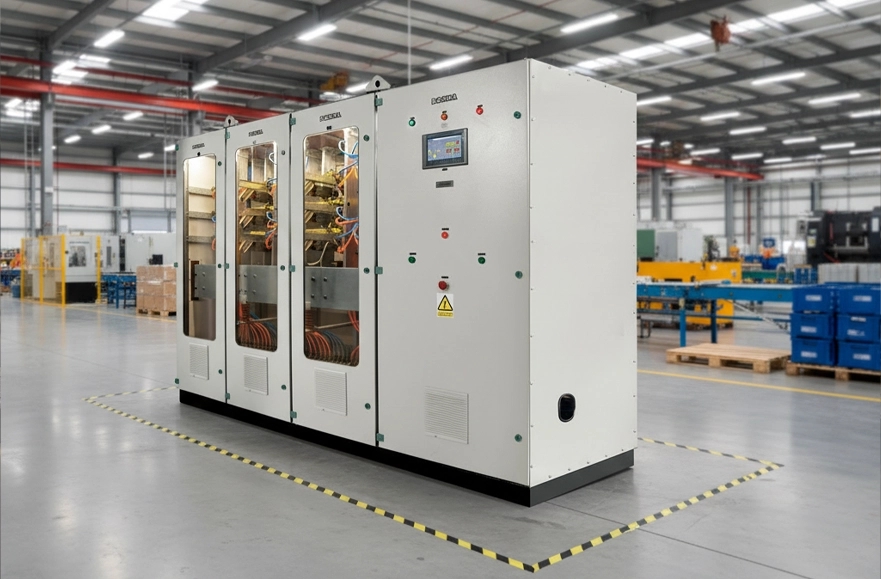
Borna Electronic Company is capable of designing and manufacturing various types of high-power transformer rectifiers for different applications in accordance with the latest international standards. This company, considering its extensive and long-standing experience in the industry, provides the most reliable products in line with the latest customer requirements.
Advantages
- Maximum electrical efficiency and minimum losses
- Minimum failure rate and maintenance costs
- Maximum safety in operating the equipment
- Maximum equipment lifetime
- Easy operation
- Appropriate, efficient, and fast after-sales service
- Minimum installation and commissioning time
Applications
High-current rectifiers have various applications in industry and are of great importance. Briefly, some of the most important applications are as follows:
- Production and purification of various metals including zinc and copper
Electrolytic refining is one of the common methods in metal production and in removing impurities after ore extraction processes. To supply the required DC electrical energy for the electrolysis process, a reliable DC converter is required. High-current transformer rectifiers consist of a set of power transformers and rectifiers for converting AC electrical power into the desired DC electrical power. This equipment supplies the DC energy required for such processes. The typical range of required electrical current, depending on the application and process scale, can vary from 5 kiloamperes to 100 kiloamperes.
- Aluminum smelting
More than 90 percent of the aluminum consumed worldwide is extracted from a material called bauxite. The extraction of aluminum metal from raw materials is carried out in several stages, one of the important stages being the electrolytic decomposition of alumina in an electrolyte solution by means of electric current. In order to supply the electrical energy required for this stage, high-current rectifiers are used. The typical range of required electrical current, depending on the process scale, can vary from 10 kiloamperes to 500 kiloamperes.
- DC electric arc furnace
The use of electric arc furnaces for the production of ferrous metals has grown significantly in recent decades. Most steel manufacturing plants use iron scrap as the primary raw material, and the metal is melted by creating an electric arc. Although AC electric arcs are also used in such industries, today, due to the important advantages of DC electric arcs, the application of such furnaces is increasing.
Among the advantages of DC arc furnaces compared to AC ones are higher efficiency, more stable electric arcs, and reduced electrode consumption. The typical range of required electrical current, depending on the process scale, can vary from 50 kiloamperes to 130 kiloamperes.
- Electroplating
Using electrolysis, a metal can be coated with a layer of other metals (deposition). This process is known as electroplating. From a technical point of view, the most important application of plating with metals is the reduction of oxidation properties (especially nickel and chromium plating). In addition, silver and gold plating are used to protect metals from corrosion in air. The typical range of required electrical current, depending on the application and process scale, can vary from 500 amperes to 10 kiloamperes.
- Electrolysis of chemical materials such as chlorine production
The process in which electrical energy is converted into chemical energy is called electrolysis. This phenomenon occurs in an environment called an electrolytic cell. For example, the chlor-alkali process is used for chlorine production. The typical range of required electrical current, depending on the application and process scale, can vary from 5 kiloamperes to 150 kiloamperes.
- Railway industry
To supply the required DC electrical energy for feeding metro traction power, high-current rectifiers are required. These rectifiers are usually installed in designated power substations at metro stations. Typically, the output voltage range of metro rectifiers is 750 to 1500 volts.
Device specifications:
- AC input
From 380 volts to 132,000 volts - DC output
Up to 500 kiloamperes and 1500 volts - Semiconductor type
Diode
Thyristor - Control method
Thyristor control
Diode control with saturable reactor (in high-power cases, regulating transformers and OLTC are used as required.) - Control type
Voltage and current adjustment and stabilization capability
Remote control and monitoring capability - Cooling type
Air-cooled
Oil-cooled
Water-cooled
Borna Electronic rectifiers are equipped with an interphase transformer, and by installing this special transformer, the following advantages will be achieved:
- Significant reduction of output voltage and current ripple
- Reduction of consumed reactive power
- Improvement of power factor
- Reduction of electrical losses and increase in efficiency
- Elimination of phase imbalance
Advantages of thyristor rectifiers compared to diode rectifiers:
- Elimination of autotransformers with on-load tap-changing capability
- Elimination of saturable reactors
- Elimination of mechanical components and reduction of maintenance costs
- Fast and easy control
All Borna Electronic products, including high-power rectifiers, are designed, manufactured, and tested based on international standards.
Some of the standards used in the production of high-power rectifiers are as follows:
IEC
IEC 60076 series
IEC 61378-1
IEC 60146
IEC 60214
IEEE
IEEE C57.12.00
IEEE C57.12.90
IEEE C57.18